
Quotes from:
- Introduction: You’re Already Using AI Wrong—Here’s How to Fix That Tonight
- From Answer-Giver to Question-Asker—The Mindset Shift That Changes Everything
- The Prompt Playbook—40+ Subject-Specific Templates for Ages 7–14
If you’ve ever typed your child’s question straight into ChatGPT and handed them the answer, you already know what AI homework help can look like when it goes wrong—and you’re not alone. In fact, most parents who end up here have done exactly that at least once.
“Your kid needed help with homework. You typed the question into ChatGPT. It spat out a full answer. Your kid copied it down and moved on.” — From the chapter “Introduction: You’re Already Using AI Wrong—Here’s How to Fix That Tonight”
That moment of relief followed by a quiet guilt is exactly where most parents are right now. The good news, however, is that there’s a better way—and it doesn’t require you to remember Year 8 algebra.
Why AI Homework Help Goes Wrong (and What to Do Instead)
The problem isn’t the AI. Instead, it’s the approach. When we hand a child a finished answer, we’ve done the thinking for them. What they actually need, then, is a thinking partner—someone (or something) that asks the right questions rather than delivering ready-made conclusions.
That’s the mindset shift at the heart of good AI homework help: move from answer-giver to question-asker. As a result, your child starts doing the cognitive heavy lifting—which is where the real learning happens.
“Your kid asks you something you don’t know the answer to. Not a vague something — a specific one, like the order of operations in a calculation. And you’re sitting there, on the sofa, and she’s on the floor with her worksheet, looking up at you expecting the answer.” — From the chapter “From Answer-Giver to Question-Asker—The Mindset Shift That Changes Everything”
Sound familiar? The fix, fortunately, isn’t knowing more—it’s prompting differently. And that’s a skill any parent can learn quickly.

The Exact Words to Type: Homework Prompts for Kids That Actually Work
Most parents freeze at the blank ChatGPT box. For example, what do you even type? Typing the question verbatim gets you a finished answer. On the other hand, typing nothing gets you nowhere.
Homework prompts for kids—carefully worded prompts designed to draw out thinking rather than replace it—are the practical tool that makes AI homework help genuinely educational. Think less “What is photosynthesis?” and more “Can you ask my 10-year-old three questions to help her figure out what photosynthesis does for a plant?” In other words, you’re using the AI to spark curiosity, not to close down the conversation.
“You’ve already opened ChatGPT. Your child is sitting next to you, homework sheet in front of them, pen in hand. The question is: what do you actually type?” — From the chapter “The Prompt Playbook—40+ Subject-Specific Templates for Ages 7–14”
The Parent Prompt Playbook gives you 40+ ready-to-use templates across math, reading, science, and writing. Additionally, they’re organized by age band so you’re not adapting a Year 10 prompt for a seven-year-old. As a result, you simply open the right page, tweak one detail, and paste. Done.
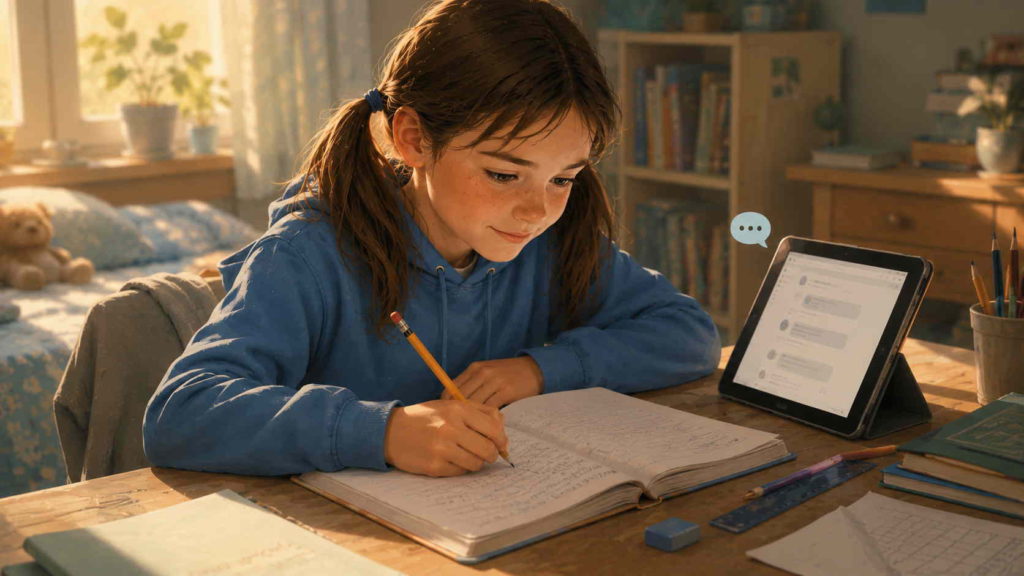
How to Avoid the Copy-Paste Trap and Avoid Homework Conflict
Even with great prompts, kids will sometimes try to shortcut the process. For instance, they paste the AI’s response straight into their exercise book and call it done. No thinking, just submit.
The solution, however, isn’t taking the laptop away—it’s a simple conversational redirect. Avoid homework conflict by asking one question before the copy-paste instinct kicks in: “Before you write that down, can you tell me what it means in your own words?”
That single habit—built into every session—is what turns AI homework help from a cheat sheet into a genuine learning tool. Because of this shift, you also move back into the role of guide rather than police officer, which makes the whole evening calmer. In addition, it means your child actually retains what they’ve worked through.
Scaffolded learning at home doesn’t require you to be an expert. Instead, it requires you to ask better questions—and now you have a playbook for exactly that.
For ChatGPT for parents who want a structured, guilt-free method that works from the very first homework session, The Parent Prompt Playbook is the practical guide you’ve been looking for. So if it’s the kind of resource you’d find useful, grab your copy and try it on the next medium-stakes homework night—you’ll notice the difference before the session is over.