
Quotes from:
- Welcome to the Challenge: How This Workbook Works (and Why Kids Lead)
- Before You Begin: Setting Up for Success (Parent Prep Guide)
Most people who search for how to declutter your room already know what they should do — the sticking point is where to start when everything looks like the problem.
This post cuts straight to a method that works, whether the room belongs to you or your eight-year-old. And once you see the category-by-category approach in action, figuring out how to declutter your room stops feeling so daunting.
How to Declutter Your Room: Start With One Category, Not One Corner
The corner-by-corner approach feels logical until you’re forty minutes in, holding a single LEGO piece, wondering whether it goes with the art supplies or the toys.
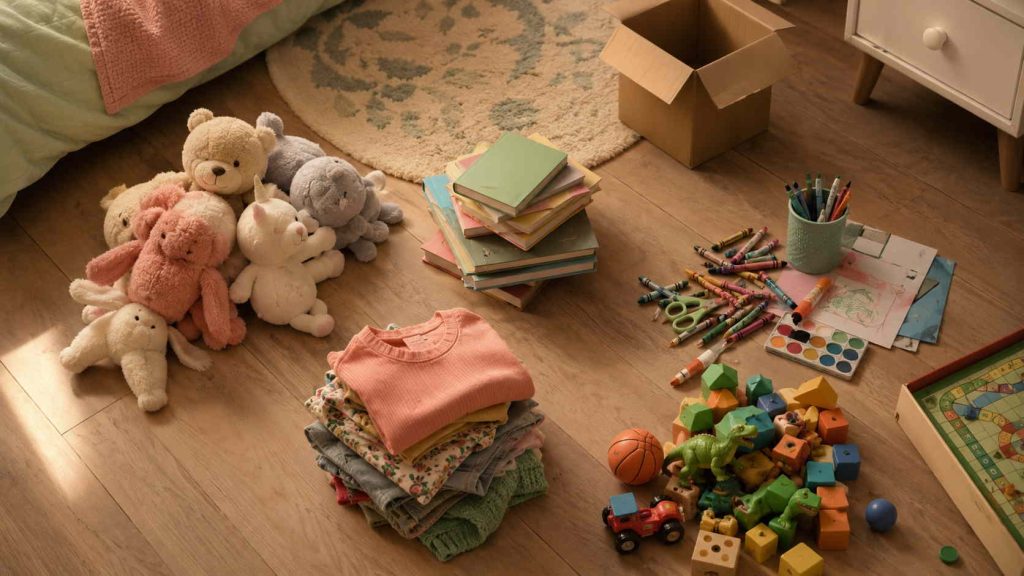
Decluttering by category is faster and makes decisions easier. Instead of moving around the room, you pull everything of one type into the middle and deal with it all at once. Stuffed animals. Books. Clothes. Art supplies. Each gets its own session.
This is how to declutter your room without the paralysis that comes from treating every surface as its own separate problem. One pile. One decision framework. Move on.
A rough category order that tends to work well:
- Stuffed animals and soft toys — emotionally loaded, but a good warm-up
- Books — easier decisions than most people expect
- Art and craft supplies — sort by usability (dried-out markers go immediately)
- Clothes — anything not worn in the last season is a strong candidate to leave
- Loose toys and games — the bulk of the work, and the category most likely to reveal missing pieces
How to Declutter Your Room Using the “Keep or Share” Question
Asking yourself do I need this? almost always ends with keeping it. The brain is wired to justify things you already own.
“Keep or share?” reframes the decision. Sharing implies the item has value — it’s just going somewhere it’ll be used more. That mental shift matters, especially for kids’ rooms, where a toy someone outgrew might be exactly what a younger child at a charity shop is looking for.
For adults, a variation that works: if I saw this in a shop today, would I pay for it again? If the answer is no without hesitation, it leaves.
Set up three physical destinations before you start: keep, donate, and bin (for things too worn to pass on). Don’t use mental categories — use actual boxes or bags on the floor. Decisions get faster once the physical spots exist. This simple setup is one of the most underrated room decluttering tips going.
How to Declutter Your Room With Kids: Why It’s a Different Problem Entirely
Kids’ bedroom clutter is its own category of frustrating because you can’t just sort it yourself without consequences.
“You’ve probably tried sorting it yourself while they were at school, which works until they notice and melt down over the one thing you donated that they ‘really needed.'” — Welcome to the Challenge: How This Workbook Works (and Why Kids Lead)
The alternative — involving them — often goes sideways for a different reason:
“You’re holding the bin bag, deciding what’s junk, asking questions that only have one right answer. The child digs in, defends everything, and suddenly you’re negotiating over a broken kazoo.” — Before You Begin: Setting Up for Success (Parent Prep Guide)
The way through this is giving the child a real role in the process — not asking for their approval on your decisions, but actually letting them lead the sorting. This takes longer the first time. It doesn’t the second time.
For kids in the 4–10 range, working through room decluttering tips one category per day keeps it manageable. A single day on stuffed animals is sustainable. “Clean your whole room” is not. In fact, when you think about how to declutter your room with a child, breaking it into daily chunks is the single biggest thing that changes the dynamic.
How to Declutter Your Room All the Way: The Last Step Most People Skip
Once the keep pile is sorted, most people stop. The donate box sits in the corner for three weeks, then quietly migrates back into the room.
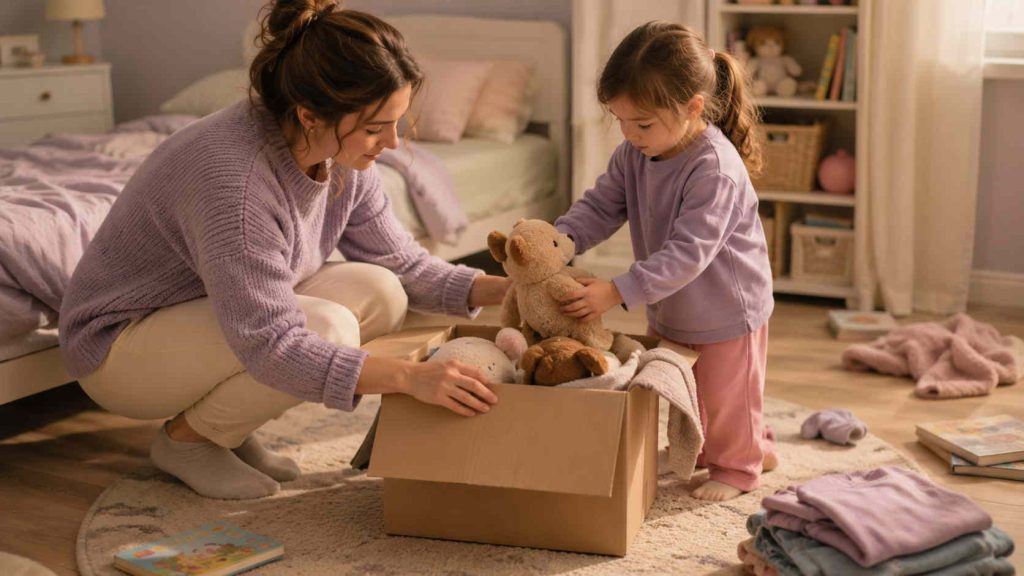
Get the donation bag out of the house the same day — or at minimum, move it to the car. The delay between deciding to donate something and actually donating it is where rooms un-declutter themselves.
For how to declutter your room with kids specifically, making the handoff official helps. Packing the box together, choosing where it goes, maybe writing a note for whoever gets it next — that’s the part they remember. It closes the loop in a way that just bagging things up doesn’t.
—
If you’re working through a child’s bedroom and want a structured framework that hands the sorting process directly to your child, Kid Clutter Kickstart: The Family Declutter Challenge Workbook walks families through a 7-day category-by-category challenge with activity sheets kids fill in themselves — one category per day, with a donation celebration at the end. Search for it if you want something you can hand straight to your child and step back from.